Chapter I · Decide

dagg.ai · 02

Decide how the company should work before deciding what to build.
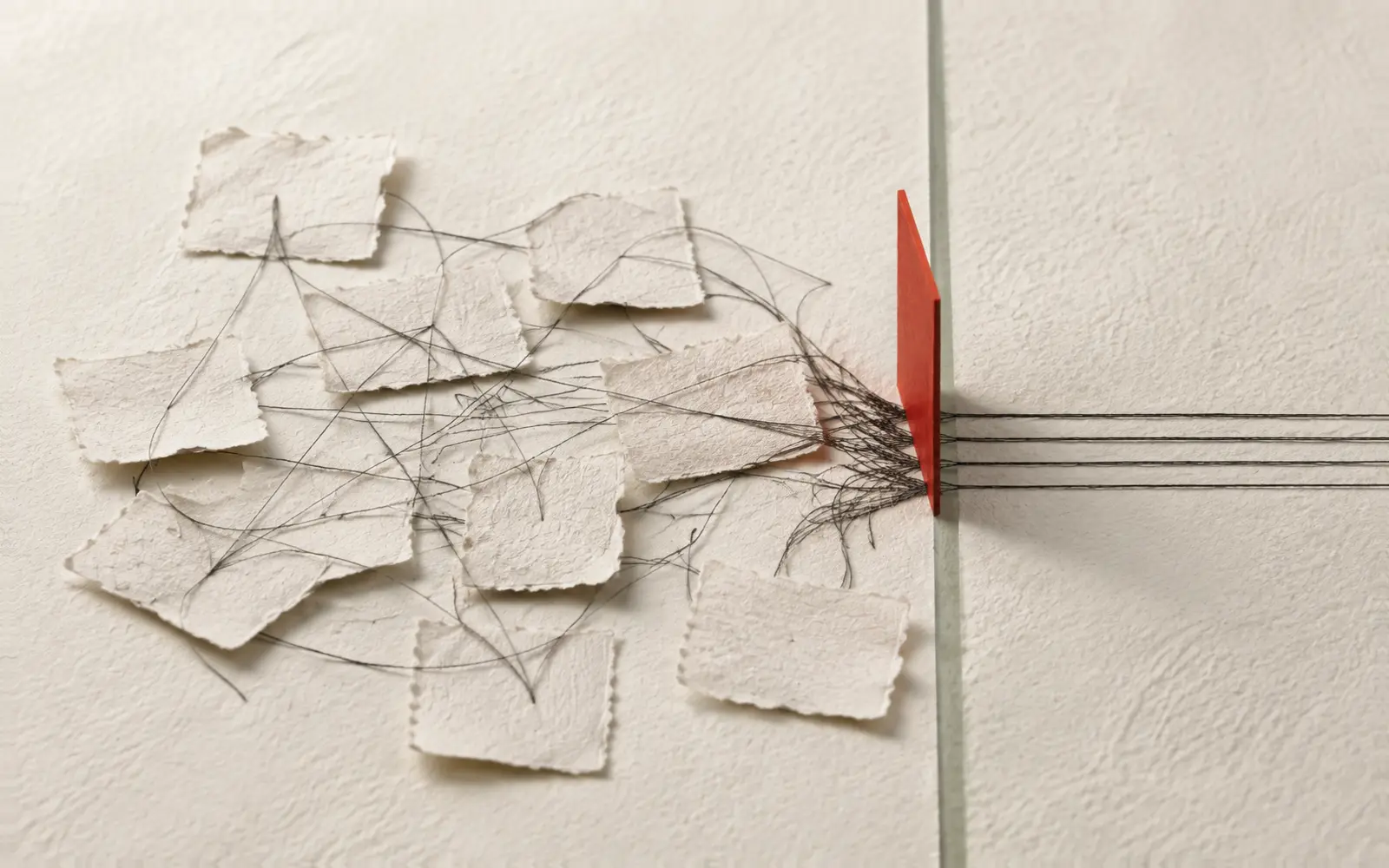
Many small sheets of paper joined by tangled thread pass one red plane and continue as a few straight parallel lines.
Plate · The work, as it isA company as it is: many parts, tangled. One decision, and the work runs straight.

Most of the time in a company is not work. It is waiting. A question waits to be noticed. A decision waits for the one person who can make it. Context waits to be explained again. We follow one path through your company, an order, a claim, a release, through every system, inbox and meeting it touches, and draw it as it is, not as the org chart describes it. Then every step on the path receives one of five verdicts. Preserve. Simplify. Automate. Rebuild. Retire. The order matters. It runs from keeping the work to stopping it, and the smallest justified change wins. Building is one answer of five, and rarely the first.

Plate II

One path.

One path through a company, as it is: seven kinds of step, through every system, inbox and meeting it touches. Every company has such paths. Distance is time.

Plate II. One path. One path through a company in seven kinds of step: received by a system, visible work, hidden work as a question asked, waiting for the answer, an exception, a person deciding, and release by a system. In the second state every step carries one of five verdicts. In the third the question and the wait are gone and the path is shorter. 1 Received by a system 2 Visible work PRESERVEAUTOMATE 3 Hidden work: a question asked 4 Waiting for the answer waiting · the longest part SIMPLIFYRETIRE 5 An exception 6 A person decides the owner 7 Released by a system the exception leaves the line and waits for the owner AUTOMATEPRESERVEPRESERVE an agent, at machine speed one path through a company · seven kinds of step

A path through a company, as it is. Distance is time.

  • System
  • Visible work
  • Hidden work
  • Waiting
  • Exception
  • Decision, with its owner

One path through a company · seven kinds of step · one verdict each

The five verdicts

Five verdicts. Building is only one of them.

Every step on the path receives one. The order matters: it runs from keeping the work to stopping it.

VerdictChoose whenDo not choose whenWho stays accountable
01PreserveKeep the work as it is. Choose whenThe work is proportionate to its value and human judgment is the value. Do not choose whenDelay, rework or unclear ownership is quietly compounding. Who stays accountableThe current owner, named explicitly.
02SimplifyRemove steps. Make the decision once. Choose whenThe same decision is taken repeatedly, or a handoff exists only because a system cannot pass context. Do not choose whenThe complexity protects a customer, a regulator or a margin. Who stays accountableThe process owner.
03AutomateKeep the system. Remove the manual work around it. Choose whenThe rules are clear, the exceptions are known and the evidence is machine-readable. Do not choose whenThe step is a judgment dressed up as a routine. Who stays accountableThe owner who approves what the agent may do and where it must stop.
04RebuildReplace the workflow, and the software, with one designed for people and agents together. Choose whenThe current system defines the work in a way that no longer makes sense. Do not choose whenThe constraint is upstream and a rebuild would only move the problem. Who stays accountableThe release owner, named before the first line of code.
05RetireStop the work. Choose whenNobody can name who depends on the output. Do not choose whenThe output is a control, not a habit. Who stays accountableThe person who signs the removal and holds the way back.

Next · Chapter II · Retain

A decision that exists only in a presentation has to be made again at the next stage.

WorkGraph keeps it attached to the work it changed.

WorkGraph Start an assessment